Wednesday, August 29, 2007

[Auromarx] It happens only once in a red moon


red moon
HUNDREDS of stargazers flocked to a rooftop car park in Richmond last night hoping to catch a glimpse of a red moon.

Unfortunately clouds made it almost impossible to see the rare lunar eclipse, but it didn't seem to bother the astronomy enthusiasts.

Astronomical Society of Victoria vice-president Terry Vlahos remained upbeat about the event despite the moon's virtual no-show.

"It's better than nothing," he said, as a sliver of the moon disappeared.

"I'm happy with the turnout and people seem to be having a good time. We can see Jupiter and some of the other constellations."

For almost an hour the moon teased the attentive crowd as it poked through the clouds before clear sky revealed the moon in all its red glory.

Christian Vasquez travelled from Deer Park for the lunar viewing.

"It's a bit unfortunate," he said. "But the turnout and the atmosphere has more than made up for it.

"It's great to see everyone having a good time, especially the kids."

Curator of Astronomy at Sydney's observatory, Nick Lomb, said most people in NSW had been able to see the eclipse.

"It's rare, but not as rare as a blue moon," he said.

While lunar eclipses occur at least twice a year somewhere in the world, the last time a total eclipse was visible from Australia's eastern states was in 2000.


--
Posted By auromarx to Auromarx at 8/29/2007 12:21:00 AM

[Auromarx] Lunar eclipse a big draw in Bandung, Jakarta


Yuli Tri Suwarni and Adisti Sukma Sawitri, The Jakarta Post, Bandung, Jakarta

Hundreds of Bandung residents flocked to the Bosscha Observatory in Lembang, North Bandung, to catch a glimpse of the total lunar eclipse on Tuesday.

Observation activities were focussed at the Van Albada Center and aired live by TVRI state-run television station.

The eight Bosscha astronomers who conducted the observation said they were satisfied, although the telescopes were only effective 10 minutes into the peak of the total lunar eclipse at 5:37 p.m.

"We were left behind for 10 minutes because the moon was obstructed by clouds. But everything turned out well ... the weather was bright and we were very satisfied with the observations today," observatory head Taufik Hidayat told The Jakarta Post at the site Tuesday evening.

With traffic backed up one kilometer along the road leading to the observatory, astronomers were forced to share the Vixen telescope with visitors.

Observations were conducted atop the Van Albada Center by using two Celestron telescopes and one William Optics, measuring 20 cm and 7 cm in diameter respectively.

It was the second time astronomers had invited the public to an event and allowed it to broadcast live on TV, after the previous Mars full Moon phenomenon on Aug. 7 2003.

A Gegerkalong resident, Rinda, 23, came with six of her roommates by public bus to witness the spectacle.

"We're satisfied because the moon was very beautiful," said Rinda.

Meanwhile in Jakarta sky gazers could not hide their disappointment as smog clouded the rare phenomenon.

But visitors at Taman Ismail Marzuki planetarium in Central Jakarta could see the eclipse peak through four telescopes and on a big screen.

"I heard that it happens once in 18 years, so I came. Too bad there were not enough telescopes so we have to queue," said Solvi, a resident of Setiabudi, South Jakarta, who came with her five-year-old daughter Sheila.

Students in Depok, however, enjoyed the day as the Kebon Maen kindergarten, primary and junior high schools management changed their study time from the regular 8 a.m. - 11 a.m. to 3 p.m.- 8 p.m. so they could observe the total lunar eclipse.

"We implemented a contextual learning system. So the eclipse is our focus of study today," the kindergarten's curriculum supervisor Sumarti M. Thahir said, adding that the students were accompanied by astronomy experts from the University of Indonesia.

Planetarium staffed Widyaswitar said that the eclipse could help show air pollution levels in an area.

"The more red the sky is, the higher the air pollution level," he said.


--
Posted By auromarx to Auromarx at 8/29/2007 12:17:00 AM

[Auromarx] Lunar eclipse a big draw in Bandung, Jakarta


Yuli Tri Suwarni and Adisti Sukma Sawitri, The Jakarta Post, Bandung, Jakarta

Hundreds of Bandung residents flocked to the Bosscha Observatory in Lembang, North Bandung, to catch a glimpse of the total lunar eclipse on Tuesday.

Observation activities were focussed at the Van Albada Center and aired live by TVRI state-run television station.

The eight Bosscha astronomers who conducted the observation said they were satisfied, although the telescopes were only effective 10 minutes into the peak of the total lunar eclipse at 5:37 p.m.

"We were left behind for 10 minutes because the moon was obstructed by clouds. But everything turned out well ... the weather was bright and we were very satisfied with the observations today," observatory head Taufik Hidayat told The Jakarta Post at the site Tuesday evening.

With traffic backed up one kilometer along the road leading to the observatory, astronomers were forced to share the Vixen telescope with visitors.

Observations were conducted atop the Van Albada Center by using two Celestron telescopes and one William Optics, measuring 20 cm and 7 cm in diameter respectively.

It was the second time astronomers had invited the public to an event and allowed it to broadcast live on TV, after the previous Mars full Moon phenomenon on Aug. 7 2003.

A Gegerkalong resident, Rinda, 23, came with six of her roommates by public bus to witness the spectacle.

"We're satisfied because the moon was very beautiful," said Rinda.

Meanwhile in Jakarta sky gazers could not hide their disappointment as smog clouded the rare phenomenon.

But visitors at Taman Ismail Marzuki planetarium in Central Jakarta could see the eclipse peak through four telescopes and on a big screen.

"I heard that it happens once in 18 years, so I came. Too bad there were not enough telescopes so we have to queue," said Solvi, a resident of Setiabudi, South Jakarta, who came with her five-year-old daughter Sheila.

Students in Depok, however, enjoyed the day as the Kebon Maen kindergarten, primary and junior high schools management changed their study time from the regular 8 a.m. - 11 a.m. to 3 p.m.- 8 p.m. so they could observe the total lunar eclipse.

"We implemented a contextual learning system. So the eclipse is our focus of study today," the kindergarten's curriculum supervisor Sumarti M. Thahir said, adding that the students were accompanied by astronomy experts from the University of Indonesia.

Planetarium staffed Widyaswitar said that the eclipse could help show air pollution levels in an area.

"The more red the sky is, the higher the air pollution level," he said.


--
Posted By auromarx to Auromarx at 8/29/2007 12:17:00 AM

Monday, August 27, 2007

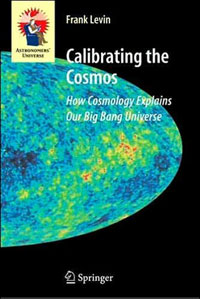
Review: Calibrating the Cosmos


book cover

Review: Calibrating the Cosmos

by Jeff Foust
Monday, August 27, 2007

Calibrating the Cosmos: How Cosmology Explains Our Big Bang Universe
by Frank Levin
Springer, 2007
hardcover, 302 pp., illus.
ISBN 0-387-30778-4
US$29.95

There is a hole in the universe. Not a black hole, mind you, but an empty space up to a billion light-years across, devoid of both visible and dark matter. That bit of vaguely disturbing news, announced by University of Minnesota astronomers last week, is hardly atypical for research on the cutting edge of astronomy. Such research involves either time and distance scales far beyond what ordinary people can easily comprehend (billions of light-years or billions of years, for example) or concepts that are utterly foreign (dark matter or dark energy). For those wishing to learn more about the universe and its origins, a good place to begin is Frank Levin's Calibrating the Cosmos.

Calibrating the Cosmos is aimed at a particular audience: people who don't know much about cosmology, but who are relatively intelligent and motivated to learn.

Levin starts with some basic principles regarding how distances are measured, be they on the Earth or in the universe, as well as some basics about electromagnetic radiation, then builds up the reader's knowledge about the universe and its origins. He examines some key issues in astronomy and cosmology, including the lives and deaths of stars, the expansion of the universe, and the origins and early history of the universe. Unlike many other astronomy books, there's very little in the way of colorful imagery of stars and galaxies in Calibrating the Cosmos; instead, Levin makes far more use of charts and graphs to illustrate his discussion of astronomical concepts like the Hubble Constant.

Calibrating the Cosmos is aimed at a particular audience: people who don't know much about cosmology, but who are relatively intelligent and motivated to learn. (Levin based the book on a course on cosmology he developed for adult education programs.) As a result, the book starts on some very basic foundations, but builds up quickly, and Levin is not afraid to pepper the text with relatively advanced terminology, variables, and a few equations. This is not Cosmology for Dummies, but instead a useful book for those who don't know a lot about cosmology but are interested in learning more and who don't need their education sugarcoated with a lot of pretty pictures. It won't help you understand why, for example, there's a hole a billion light-years across in the universe—not even the astronomers who found it know why it exists—but it will help you understand the significance of such discoveries.


Jeff Foust (jeff@thespacereview.com) is the editor and publisher of The Space Review. He also operates the Spacetoday.net web site and the Space Politics and Personal Spaceflight weblogs. Views and opinions expressed in this article are those of the author alone, and do not represent the official positions of any organization or company, including the Futron Corporation, the author's employer.


--
Posted By auromarx to Where spiritualism meets materialism at 8/27/2007 11:31:00 PM

Gaping "Hole" in the Sky Found, Expert...

There is a yawning gap of sky nearly a billion light-years across that contains no matter, a new study suggests.

But some researchers aren't buying it, in part because it would be a monumental surprise to find a void that large.

When seen on the scale of tens of millions of light-years, the universe has a foamy structure, with galaxies arranged as if on strings or sheets, with little matter in between them.

This arrangement applies to both visible matter that pumps out light, such as stars, and the mysterious dark matter, whose existence can be inferred only indirectly from how it holds galaxies together.


A "cold spot" in the universe lacks much of the normal cosmic background radiation, left over from the Big Bang, that ripples through the rest of the sky (left, with blue representing colder spots).

Researchers studied radio-wave-emitting galaxies (right) and found such sources were not responsible for the low-radiation region.

The team therefore speculates the spot is an empty hole that is devoid of both regular and dark matter—a structure completely unexpected in modern theories of the universe.

Image courtesy Rudnick et al., NRAO/AUI/NSF, NASA

But at much larger scales, about 150 million light-years and beyond, researchers had expected the universe would be more uniform—so finding a void nearly a billion light-years across was a shock.

"Not only has no one ever found a void this big, but we never even expected to find one this size," said study lead author Lawrence Rudnick of the University of Minnesota in Minneapolis.

Rudnick and colleagues Shea Brown and Liliya Williams report their findings in a paper accepted for publication in the Astrophysical Journal.

Unusual Spot of Sky

The researchers began looking at this particular spot in the sky because it already showed a strange feature.

There the cosmic microwave background radiation—low-level light left over from the birth of our universe that bathes all of space—is especially dim.

This dark patch—where the sky appears "cooler"—is known as the "WMAP cold spot," named after the Wilkinson Microwave Anisotropy Probe satellite that mapped the radiation in 2003.

Nationalgeographic


--
Posted By auromarx to Where spiritualism meets materialism at 8/27/2007 11:21:00 PM

Dark Matter Mystery Deepens In Cosmic ...


Astronomers have discovered a chaotic scene unlike any witnessed before in a cosmic "train wreck" between giant galaxy clusters. NASA's Chandra X-ray Observatory and optical telescopes revealed a dark matter core that was mostly devoid of galaxies, which may pose problems for current theories of dark matter behavior.

"These results challenge our understanding of the way clusters merge," said Dr. Andisheh Mahdavi of the University of Victoria, British Columbia. "Or, they possibly make us even reexamine the nature of dark matter itself."

There are three main components to galaxy clusters: individual galaxies composed of billions of stars, hot gas in between the galaxies, and dark matter, a mysterious substance that dominates the cluster mass and can be detected only through its gravitational effects.

Optical telescopes can observe the starlight from the individual galaxies, and can infer the location of dark matter by its subtle light-bending effects on distant galaxies. X-ray telescopes like Chandra detect the multimillion-degree gas.

A popular theory of dark matter predicts that dark matter and galaxies should stay together, even during a violent collision, as observed in the case of the so-called Bullet Cluster. However, when the Chandra data of the galaxy cluster system known as Abell 520 was mapped along with the optical data from the Canada-France-Hawaii Telescope and Subaru Telescope atop Mauna Kea, HI, a puzzling picture emerged. A dark matter core was found, which also contained hot gas but no bright galaxies.

"It blew us away that it looks like the galaxies are removed from the densest core of dark matter," said Dr. Hendrik Hoekstra, also of University of Victoria. "This would be the first time we've seen such a thing and could be a huge test of our knowledge of how dark matter behaves."

In addition to the dark matter core, a corresponding "light region" containing a group of galaxies with little or no dark matter was also detected. The dark matter appears to have separated from the galaxies.

"The observation of this group of galaxies that is almost devoid of dark matter flies in the face of our current understanding of the cosmos," said Dr. Arif Babul, University of Victoria. "Our standard model is that a bound group of galaxies like this should have a lot of dark matter. What does it mean that this one doesn't""


This multi-wavelength image shows the chaotic aftermath of the collision of at least two galaxy clusters, some of the most massive objects in the universe. X-rays from Chandra (red) show the hot gas the envelopes the clusters. The individual galaxies appear in visible-light observations (yellow and orange), which also reveal the presence of dark matter (blue) by the subtle distortions of the distant objects. The behavior of the dark matter with respect to the galaxies and hot gas in Abell 520 is very unusual. These data can be explained by changes to the current understanding of dark matter or how galaxy clusters interact when merging. (Credit: X-ray: NASA/CXC/UVic./A. Mahdavi et al. optical/lensing: CFHT/UVic./H. Hoekstra et al.)

In the Bullet Cluster, known as 1E 0657-56, the hot gas is slowed down during the collision but the galaxies and dark matter appear to continue on unimpeded. In Abell 520, it appears that the galaxies were unimpeded by the collision, as expected, while a significant amount of dark matter has remained in the middle of the cluster along with the hot gas.

Mahdavi and his colleagues have two possible explanations for their findings, both of which are uncomfortable for prevailing theories. The first option is that the galaxies were separated from the dark matter through a complex set of gravitational "slingshots." This explanation is problematic because computer simulations have not been able to produce slingshots that are nearly powerful enough to cause such a separation.

The second option is that dark matter is affected not only by gravity, but also by an as-yet-unknown interaction between dark matter particles. This exciting alternative would require new physics and could be difficult to reconcile with observations of other galaxies and galaxy clusters, such as the aforementioned Bullet Cluster.

In order to confirm and fully untangle the evidence for the Abell 520 dark matter core, the researchers have secured time for new data from Chandra plus the Hubble Space Telescope. With the additional observations, the team hopes to resolve the mystery surrounding this system.

These results are scheduled to appear in the October 20th issue of The Astrophysical Journal. Other members of the research team included David Balam (University of Victoria) and Peter Capak (California Institute of Technology).

Note: This story has been adapted from a news release issued by Chandra X-ray Center.

Sciencedaily


--
Posted By auromarx to Where spiritualism meets materialism at 8/27/2007 11:12:00 PM

Race Is on to Detect Dark Matter

LOS ANGELES -

In deep underground laboratories around the globe, a high-tech race is on to spot dark matter, the invisible cosmic glue that's believed to keep galaxies from spinning apart.

Whoever discovers the nature of dark matter would solve one of modern science's greatest mysteries and be a shoo-in for the Nobel Prize. Yet it's more than just a brainy exercise. Deciphering dark matter - along with a better understanding of another mysterious force called dark energy - could help reveal the fate of the universe.

Previous hunts for the hypothetical matter have turned up nothing, but that has not deterred some two dozen research teams from plumbing the darkness of idled mines and tunnel shafts for a fleeting glimpse.

Dark-matter detecting machines today are more powerful than previous generations, but even the best has failed so far to catch a whiff of the stuff. Many teams are now building bigger detectors or toying with novel technologies to aid in the hunt.

"We're in the golden age of dark matter search," said Sean Carroll, a California Institute of Technology theoretical physicist who has no role in the experiments. "It's looking good for some breakthroughs to happen."

Scientists admittedly are still in the dark about dark matter. The prevailing theory is that it's made up of tiny, exotic particles left over from the Big Bang some 13.7 billion years ago. Dark matter, thought to make up a quarter of the universe's mass, gets its name because it doesn't give off light or heat. Astronomers know it exists because of its gravitational tug-of-war with stars and galaxies.

Knowing that dark matter exists is a far cry from knowing what it is. Most experiments are searching for theoretical particles called WIMPS - or weakly interacting massive particles - the leading dark-matter candidate.

The underground custom-built machines are all waiting for the rare moment when a WIMP hits the atomic nucleus and causes an elastic recoil. Experiments have to run below ground to prevent cosmic rays from interfering with the results.

Dark matter researcher Neil Spooner of Sheffield University in England sums it up this way: "You have a needle in a haystack and you're trying to remove the hay. You need better technology to pull out the event you're looking for and reject the rubbish."

Subterranean experiments are humming in an idled iron mine in Minnesota and in caverns in Canada, England, France, Italy, Japan and Russia. Last month, the National Science Foundation chose the defunct Homestake gold mine in South Dakota to be the site of one of the largest and deepest labs of its kind in the world - bigger than six Empire State Buildings stacked below ground.

The competition is cutthroat and physicists spar over which technology works best.

The front-runner for the past several years, called CDMS for cryogenic dark matter search, uses ultracold silicon and germanium crystals each the size of a hockey puck to sift out telltale vibrations of a WIMP collision. Newer contraptions use noble gas such as xenon or emerging technologies like superheated liquid bubble chambers.

"There's no perfect dark matter experiment or detector. All of them have their quirks and limitations," said Juan Collar, a particle physicist at the University of Chicago and part of a team called COUPP.

Scientists realize they may be in for a reality check.

"It's possible that no matter how big of an experiment you build, you may not find anything," said Steve Ahlen of Boston University, who along with collaborators from the Massachusetts Institute of Technology and Brandeis University, is building a prototype that will be placed underground next year in a yet to be determined location.

There have been false alarms. In 2000, Italian scientists working in an underground lab near Italy's Gran Sasso mountain range claimed to have detected a dark matter signal. But no one has been able to reproduce the result and the claim is not widely recognized in the scientific community. The Italian researchers have since been working on a second-generation detector and expect to present new results next year.

This spring, a rival group led by Columbia University's Elena Aprile, who also works in Gran Sasso, shocked her peers by announcing at a science meeting that her liquid gas project called XENON10 is more sensitive and rejects more background noise than the CDMS detector.

"The more sensitivity you have, the closer you get to the truth," Aprile said.

CDMS spokesman Bernard Sadoulet of the University of California, Berkeley, said it helps to have more than one technology searching for dark matter to cross-check results. He added that his team has been taking data with its scaled-up detector since last year and expects to regain the sensitivity lead.

The quest for dark matter dates back to the 1930s when Swiss astronomer Fritz Zwicky of Caltech, peering through his telescope, determined that there's missing mass in the universe by observing celestial motions. The idea took a while to catch on, but is now the subject of an intense underground hunt.

Dark matter detectors are expensive to build and even pricier to upgrade and operate. Many projects are funded by a mix of sources. For example, the National Science Foundation has invested about $21 million since fiscal year 2000 on six projects including CDMS and XENON10.

Scientists are also searching for dark matter in space. NASA next year plans to launch the GLAST telescope to study gamma ray bursts that may be created by dark matter collisions. And it's possible researchers will create dark matter in the lab - like at the Large Hadron Collider buried beneath the Swiss-French border - even before they confirm it in the cosmos or under ground.

Not all dark matter searches are betting their money on WIMPS.

The Axion Dark Matter Experiment at Lawrence Livermore National Laboratory has been searching for another theoretical particle called axions. The first phase of the project ended in 2003 with no signal. It recently got the green light from the Energy Department to upgrade the experiment.

Just how long the dark matter hunt will go on is anybody's guess.

"The crystal ball is fuzzy," said physicist Leslie Rosenberg, a co-spokesman of the axion project, adding that, "The nature of dark matter will be revealed."

Forbes


--
Posted By auromarx to Where spiritualism meets materialism at 8/27/2007 11:06:00 PM

Aperture and telescope

Are two important features that must be taken care of